
Lapeer County Court Records After Jail Arrest
The local path is arrest, booking, arraignment, prosecutor charge review, and then a public court case where access is allowed. Lapeer County Jail handles the custody side for people arrested by law enforcement agencies in the county. District Court 71A is the usual first court stop because it handles arraignments, bond, misdemeanors, and felony preliminary examinations. Michigan Court Rule Chapter 6 also places the first-appearance point in the court process by requiring an arrested person to be taken before court for arraignment without unnecessary delay unless released first.
The key distinction is simple. Jail records tell whether the person was booked, held, bonded, or released. Court records after jail arrest show the legal case that follows: the filed charges, case number, court dates, bond conditions, amendments, dismissals, pleas, verdicts, and sentencing. For custody and booking detail, use Lapeer County jail inmate records. For booking-photo access and limits, use Lapeer County jail mugshots. The court page of the process should not be treated as a generic arrest-record search.
The official District Court 71A criminal cases page explains the arraignment step, including notice of charges, rights, bond eligibility, bond type, bond amount, conditions, and the next court date. That local protocol is the bridge from booking to the formal record.
The county's District Court criminal protocol is shown in this official source image.
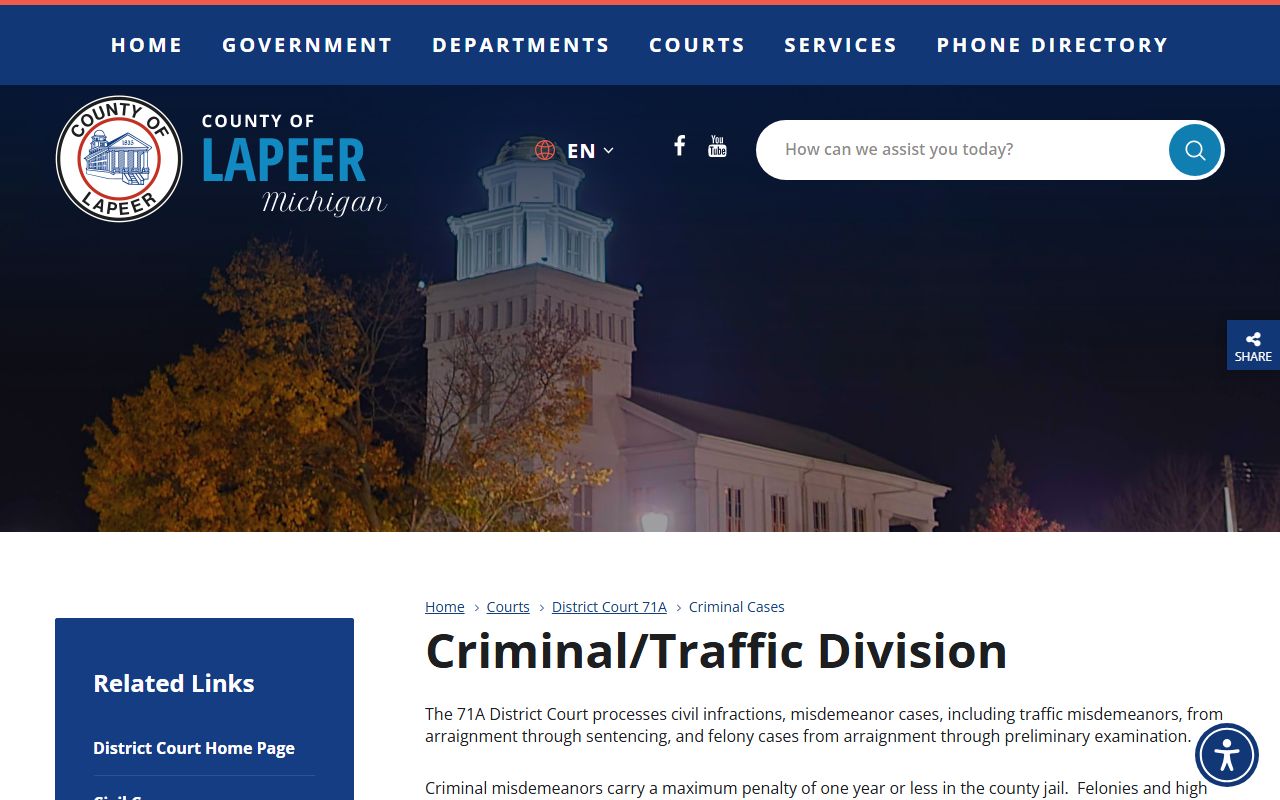
That court source is useful because it confirms how arraignment, bond, misdemeanors, and felony preliminary proceedings fit into Lapeer County court records after a jail arrest.
Find Lapeer County Court Records
The county courts page links public users to MiCOURT Case Search for online case lookup and to local docket pages for judge and magistrate dockets. MiCOURT is the main online route for charges and case activity after a Lapeer County arrest, but the county court or clerk counter remains important for older records, records not indexed online, sealed material, or questions about access. District Court covers the misdemeanor path and felony early stages. The 40th Circuit Court Clerk handles felony cases after bindover and other circuit case records.
Search quality improves when the user has a case number, the defendant's full name, and the court level. A booking call to the jail may confirm custody and may produce a court date or charge description, but court records after arrest should still be checked through the court source. The prosecutor may authorize charges that differ from the initial booking language, so the case record is the better source for filed counts.
| MiCOURT Field | Type | Required | Use in a Lapeer County Arrest Case |
|---|---|---|---|
| Court selection or court type | Portal selection | Required by flow | Start with the Lapeer court context when narrowing a local case. |
| Party or defendant name | Text | Optional or conditional | Use when the case number is not yet known. |
| Case number | Text | Optional or conditional | Best when copied from a court notice, bond receipt, docket, or clerk response. |
| Date or case filters | Filter | Optional | Useful when several people share a name or the arrest date is known. |
| Search or submit | Button | Required action | Runs the JavaScript case-search portal. |
The official Lapeer County court dockets page also links to magistrate, district judge, and circuit judge dockets. Dockets are not a full case file, but they can show timing for arraignment, preliminary examination, and later hearings.
Search Charges After Arrest
A charge search works best when it follows the same order as the case. First, confirm whether the person is in county custody. Next, look for the first court activity. Then read the filed charges in MiCOURT or through the court clerk. Do not assume the booking wording is final, because police arrest language may change after prosecutor review.
- Confirm county custody through the sheriff app inmate tab or by calling Lapeer County Jail at 810-664-1801 ext. 2314 or 2315.
- Ask for a court date, arresting agency, case number, or charge description if staff can release it.
- Check the District Court magistrate docket for first-appearance or arraignment activity.
- Use MiCOURT by defendant name or case number once the case posts.
- For misdemeanors, keep checking District Court 71A through disposition or sentencing.
- For felonies, follow the District Court preliminary-exam stage and then the 40th Circuit Court if the case is bound over.
- Contact the court clerk if the case is older, sealed, suppressed, or not visible online.
Michigan State Police ICHAT is a separate statewide criminal-history tool. It can help with public criminal-history records for some felony and serious misdemeanor convictions, but MSP warns that suppressed records and warrant information are not available through ICHAT. It is not a live Lapeer County warrant search or a same-day jail roster.
Lapeer County Charging Documents
After a Lapeer County jail arrest, the prosecutor reviews the police report and alleged facts before authorizing charges under Michigan law. The Lapeer County Prosecutor's Office, led by Prosecuting Attorney John D. Miller, is the local charging authority for state criminal law violations in the county. The prosecutor may approve the arrest charge, authorize a different count, decline a count, add charges, reduce charges, or later amend the case.
| Document | Who Uses It | Where It Fits | Plain Meaning |
|---|---|---|---|
| Complaint | Prosecutor or sworn complainant | Often begins the District Court case | The starting accusation that states the alleged offense. |
| Information | Prosecutor | Used in felony cases after district-court proceedings | The formal felony charging document after bindover or waiver. |
| Indictment | Grand jury process when used | Less common than complaint-based charging | A grand-jury charge that can start or shape a criminal case. |
The official Lapeer County Prosecutor's Office page gives the local office context and victim-assistance links. Prosecutor data belongs in the court-record path because the prosecutor's filing decision is what turns arrest facts into charge records.
Lapeer County Charge Status
Charge status terms explain what happened to each count. A person can have several counts in one case, and each count may end in a different way. One charge may be dismissed while another is reduced or resolved by plea. A felony may begin in District Court, move through preliminary examination, and then be bound over to Circuit Court. A misdemeanor may stay in District Court from arraignment through sentencing.
| Status | What It Means | Why It Matters |
|---|---|---|
| Pending | The count or case is open. | No final outcome has been entered. |
| Amended | The filed charge changed after the first filing. | The final court charge may differ from the jail booking description. |
| Reduced | The charge was lowered, often through amendment or plea. | The conviction, if any, may be for a lesser offense. |
| Dismissed | The count or case ended without conviction on that charge. | It should not be described as a conviction. |
| Bound over | A felony moved from District Court to Circuit Court. | Further case records may be in the 40th Circuit Court. |
| Set aside | An eligible record was later limited from public access. | Public search results may change under Michigan law. |
Lapeer County Bond Records
Bond is set at arraignment in the court pathway. District Court 71A says the magistrate determines release eligibility and, if release is allowed, sets bond type, bond amount, and bond conditions. Lapeer County Jail publishes practical bond channels: cash bonds may be posted in the jail lobby, online, or directly through the courts. Posting at the courthouse is the county-identified way to avoid bond-posting fees. Credit and debit cards are accepted at the jail lobby kiosk, and jail staff can be notified if kiosk help is needed.
Cash-bond receipts must be in the name of the person being bonded, not the payer. The county also warns that bond and commissary deposits are different account types, and a wrong-account deposit can cause delay. A surety bond may be posted through a court-approved agency, but the jail does not endorse a company or take part in the defendant's contract with the agency.
| Bond Channel | Local Detail |
|---|---|
| Jail lobby cash or card | Available through the lobby kiosk, with service fees possible. |
| Online bond deposit | Uses the county-linked Express Account route. |
| Courthouse posting | The local fee-avoidance route identified by county jail information. |
| Surety bond | May be handled by a court-approved agency, with no jail endorsement. |
| Hold or no-release status | A detainer, outside warrant, probation/parole hold, ICE matter, or court order may prevent release. |
Lapeer County Warrants After Arrest
No official Lapeer County sheriff active-warrant search page was found in the county sources inspected. That means warrant content should be routed through real channels instead of framed as a county warrant database. A bench warrant may appear in court case activity or docket entries if public access allows it. District Court 71A can be contacted for misdemeanor and felony preliminary matters, while the Circuit Court Clerk handles felony circuit files after bindover.
If a warrant has already led to arrest, the custody channel is the sheriff app inmate tab or the jail information extensions. If the issue is a parole or probation absconder, MDOC OTIS has offender-status filters for Parole Absconders and Probation Absconders. ICHAT should not be used as a warrant search because Michigan State Police says warrant data is not available there.
Charges and Convictions
An arrest charge is an accusation, not a conviction. A court record after arrest can show both the allegation and the final outcome, but those two points should not be merged. A conviction requires a plea or finding of guilt. An acquittal means the person was found not guilty. A dismissal means the count ended without conviction on that count.
| Point of Comparison | Charge | Conviction |
|---|---|---|
| Stage | Filed accusation after arrest review | Final or resolved finding of guilt |
| Proof level | Based on charging and probable-cause standards | Requires plea or proof beyond a reasonable doubt |
| Record language | May be pending, amended, reduced, or dismissed | Should identify the exact offense of conviction |
| Use caution | Never call it guilt by itself | Check disposition and sentence before relying on it |
Sealed and Expunged Records
Michigan uses set-aside and Clean Slate rules for eligible criminal records. MCL 780.621 is the main set-aside statute, and Michigan State Police publishes Clean Slate public information for automatic set-aside timing for eligible felony and misdemeanor convictions. A set-aside can limit public access, but it does not mean every private copy or old web reference vanishes. Court and agency systems may also restrict juvenile matters, sealed cases, active investigative records, and records exempt from Michigan FOIA.
| Comparison | Sealed or Restricted | Set Aside or Expunged |
|---|---|---|
| Public view | Hidden or limited by rule, order, or case type | Limited from public access if eligible and granted or automatic |
| Legal basis | Court rule, statute, juvenile rule, or court order | MCL 780.621 and Clean Slate rules |
| Agency access | Some official access may remain | Some law-enforcement or court access may remain under law |
| Best next step | Ask the court clerk about access status | Review Michigan Clean Slate and court instructions |
Important: Public case access can be incomplete, delayed, or restricted, so verify charge status with the court that owns the file.